Filmmakers and content creators spend a significant amount of time looking at screens. We review footage on location, edit projects on laptops, watch reference videos, check client revisions and sometimes try to finish work while travelling. A large studio monitor is comfortable, but it is not something we can easily take onto a train, plane or film set.
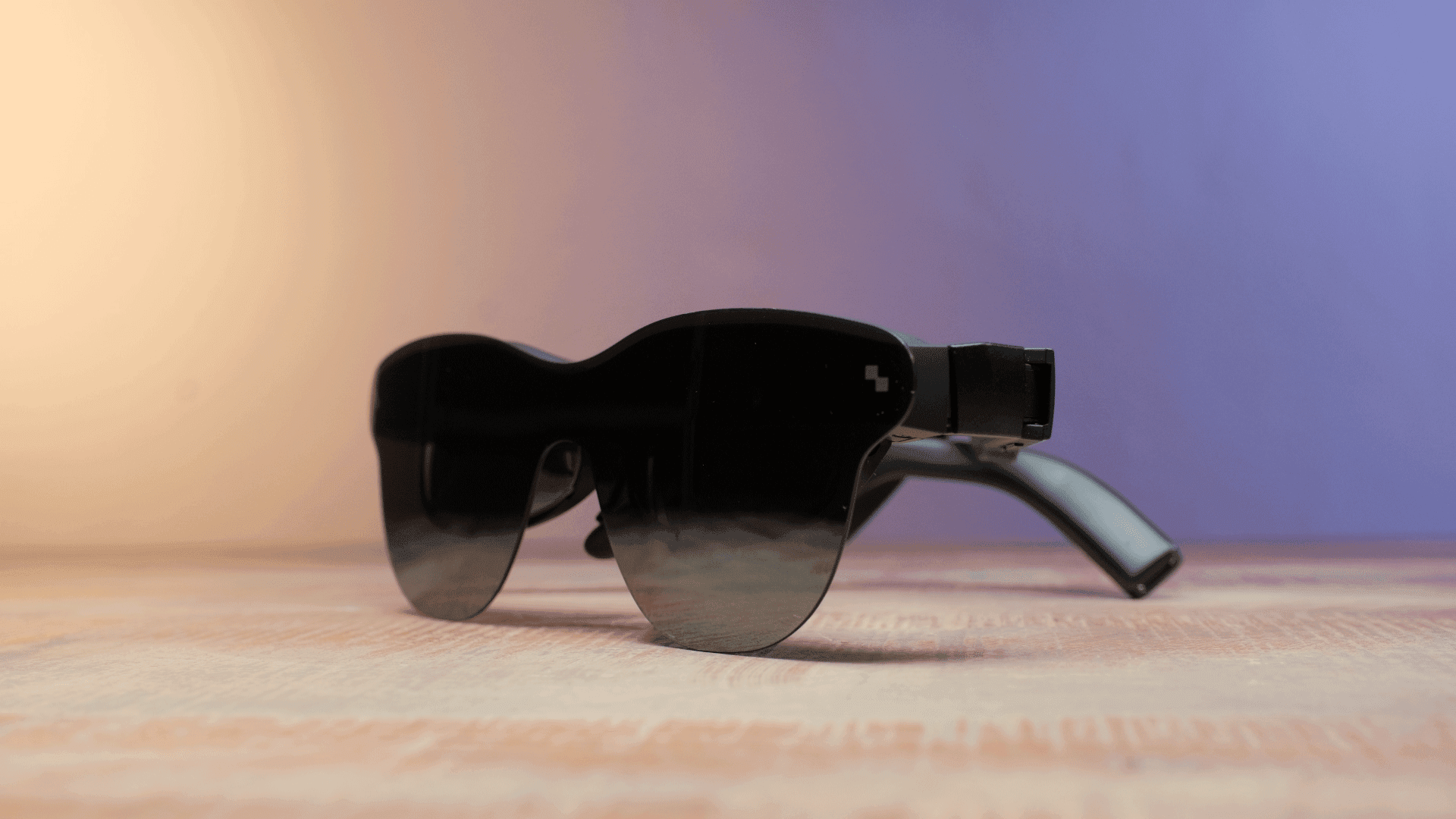
The RayNeo Air 4 Pro AR Glasses offer a different approach. Instead of placing another physical monitor in front of you, the glasses create a large virtual display that can be connected to compatible smartphones, tablets, laptops and gaming devices.
From a filmmaker’s perspective, this makes the product interesting not only for entertainment, but also as a portable screen for selected parts of a creative workflow.
A Large Personal Display in a Compact Format
The central feature of the RayNeo Air 4 Pro is its virtual 201 inch display with a 46 degree field of view. The glasses use 0.6 inch micro OLED displays and provide a resolution of 1920 by 1080 in 2D mode. They also support a refresh rate of up to 120 Hz.
In practice, the screen appears in front of the wearer while the connected device provides the actual content. This could be a movie playing from a smartphone, an editing timeline displayed by a laptop or a presentation that needs to be reviewed before a client meeting.
For filmmakers working away from the studio, this creates an interesting alternative to relying exclusively on a relatively small laptop display. The glasses do not physically increase the resolution of the connected computer, but they can make the viewing experience feel much larger and more focused.
The private nature of the display can also be helpful while travelling. When reviewing project files, scripts, presentations or footage in a public environment, the content is not displayed on an openly visible monitor. People nearby may still see that the glasses are connected to a device, but they cannot simply look over your shoulder and see the full screen.
Display Characteristics Relevant to Creators
RayNeo specifies a brightness of up to 1,200 nits, a contrast ratio of 200,000:1, coverage of 98 percent of the DCI P3 colour space and colour accuracy of Delta E below 2. The glasses also provide six picture modes, including Standard, Movie, Professional, Eye Protection and Vision Boost modes. Brightness can be adjusted across 20 levels.
These specifications are relevant because filmmakers regularly work with visually detailed material. Strong contrast can help darker scenes remain readable, while wide colour coverage can make videos, photographs and graphics appear more expressive.
The Professional mode is particularly interesting for creative work, although the glasses should not automatically be treated as a replacement for a calibrated reference monitor. Final colour grading, exposure evaluation and professional mastering should still be completed on a properly calibrated display in a controlled environment.
For reviewing an edit, checking pacing, watching a rough cut or evaluating the general visual direction of a project, however, the large virtual screen could be a useful addition to a mobile setup.
The RayNeo Air 4 Pro also supports HDR10 content. According to RayNeo, its Vision 4000 processing can convert SDR material into an HDR style presentation in real time. This may provide a more dynamic entertainment experience, but filmmakers should keep in mind that processed playback does not necessarily represent the original image created during editing or grading.
Connecting the Glasses to a Creative Setup
The glasses connect through USB C and require a device that supports DisplayPort video output through its USB C connection. Compatible devices include selected smartphones, tablets, laptops and handheld consoles. RayNeo lists recent USB C iPhones, various Android smartphones, iPads, MacBooks and Windows laptops among the supported product categories.
For a filmmaker, the most practical configuration would probably be a direct connection to a laptop. Once connected, the virtual display can be used for applications that would normally appear on an external monitor.
This opens several possible workflows. A filmmaker could review a full screen video while keeping editing controls on the laptop display, watch tutorial material while working, organise footage, check subtitles or review a client presentation without carrying a portable monitor.
Compatibility should always be checked before purchasing. A USB C connector alone does not guarantee that a device can output video. The port must support DisplayPort functionality, or an appropriate adapter may be required for devices that only provide HDMI output.
Comfort During Longer Viewing Sessions
At 76 grams, the RayNeo Air 4 Pro is considerably lighter than a traditional virtual reality headset. The frame includes adjustable nose pads and flexible temples, allowing the position of the glasses to be adapted to the wearer. Its dimensions are listed as 176.5 by 154.3 by 47.4 millimetres.
This compact design is important for mobile creative work. A device intended for travel or location use needs to fit into an equipment bag without adding another large case.
RayNeo also includes 3,840 Hz PWM dimming and lists low blue light and flicker free certification. These features are intended to support visual comfort during longer viewing sessions.
Nevertheless, wearing a display directly in front of the eyes is different from using a conventional monitor. Regular breaks remain sensible, particularly during long editing sessions. Individual comfort can also depend on eyesight, facial structure, the adjustment of the nose pads and how well the virtual image aligns with the wearer’s eyes.
Prescription lens inserts are available separately through a third party partner for users who require vision correction.
Integrated Audio for Videos and Presentations
The RayNeo Air 4 Pro includes a four speaker audio system developed in cooperation with Bang & Olufsen. It provides Surround Mode and Whisper Mode, with the latter designed to reduce how much sound reaches nearby people.
Integrated audio makes the glasses convenient for watching videos without immediately connecting additional equipment. This could be useful when reviewing an edit, checking a presentation or watching educational content.
For professional audio decisions, however, filmmakers should continue using suitable headphones or studio monitors. Integrated speakers can make dialogue and general sound design easy to follow, but they are not intended to replace a controlled audio monitoring setup for mixing.
Whisper Mode may be particularly practical while travelling or working around other people. It cannot guarantee complete privacy, but it offers an option for keeping the perceived volume more focused around the wearer.
Movies, 3D Content and Creative Inspiration
Outside professional work, the RayNeo Air 4 Pro is primarily designed as a personal entertainment display. It supports native 3D material, while the RayNeo Air Series app offers 2D to 3D conversion and ultrawide display optimisation on compatible platforms.
For filmmakers, watching movies is often more than entertainment. Films, documentaries, commercials and music videos provide references for lighting, composition, production design, camera movement and editing.
A portable virtual cinema makes it possible to study this kind of content without requiring a television or projector. The 120 Hz refresh rate also creates smooth motion for compatible content, although most cinematic productions will continue to play at their original frame rate.
Where the RayNeo Air 4 Pro Fits into a Filmmaking Workflow
The RayNeo Air 4 Pro should not be viewed as a complete replacement for a professional production monitor, calibrated grading display or editing workstation. It is better understood as an additional portable display.
Its strongest filmmaking use cases are likely to include reviewing rough cuts, watching reference material, presenting content privately, extending a laptop based workspace and consuming media while travelling.
The combination of a large virtual image, micro OLED displays, USB C connectivity, adjustable picture modes and a relatively lightweight frame makes the glasses an interesting option for creators who regularly work outside a permanent studio.
For colour critical decisions and detailed technical evaluation, a conventional calibrated monitor remains essential. For general viewing, mobile productivity and private content review, however, the RayNeo Air 4 Pro introduces a flexible way to carry a large personal screen inside a compact equipment bag.
For filmmakers who already travel with a compatible laptop, tablet or smartphone, that portability may ultimately be the product’s most relevant advantage.
Official Store: https://eu.rayneo.com/products/rayneo-air-4-pro-ar-glasses?utm_source=kol-FenchelJanisch2&utm_medium=tech&utm_campaign=Air-4pro
Amazon: https://www.amazon.de/dp/B0G56M1SVH?maas=maas_adg_39902970453A052698B9913C537E8546_afap_abs&ref_=aa_maas&tag=maas